
COMPASS
HOW TO READ THIS MAP
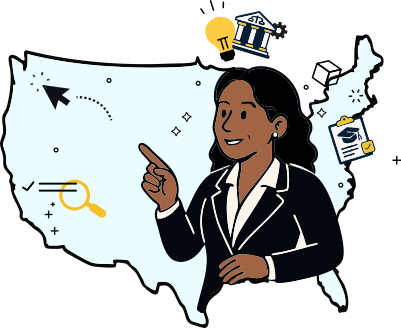
Britebound believes Career Readiness encompasses three essential principles: Youth should have opportunity to 1) explore careers as early as middle school; 2) experiment with work-based learning before leaving high school; and 3) successfully navigate to postsecondary education and career. We have identified 18 core policies1 associated with these principles and tracked their adoption in all 50 states and the District of Columbia2. States that are shaded with a darker color have adopted more of the 18 policies critical for advancing career readiness than the states that are shaded with a lighter color.
The 18 core policies are:
Explore
- State formally defines career exploration for middle school students.
- State requires middle school students to complete career exploration activities.
- State uses state or federal funding sources to support career exploration for middle school students.
- State supports the training of school counselors (and other school staff) in career exploration.
- State has established standard practices for career exploration in middle schools.
- State collects data on middle school career exploration opportunities in the state.
Experiment
- State has a formal definition of WBL that includes opportunities for high school students.
- All high school students are eligible for WBL opportunities and eligibility is not restricted to students enrolled in specific programs.
- State has dedicated source of state funding for WBL.
- State has system or organization designed to facilitate WBL opportunities and/or public-private partnerships that support access to paid or for-credit WBL opportunities for high school students.
- State has statewide framework in place that defines quality expectations for WBL programs and holds schools/districts accountable to those expectations.
- State has process in place to track student participation in WBL opportunities and their outcomes.
Navigate
- State has set a clear, refined, and explicit definition of quality or value for short-term credential programs and restricts the use of state funds only to programs adhering to this quality criteria.
- State financial aid is available for short-term, in-demand programs so they are free or low-cost for students in need.
- State prioritizes federal Perkins V state leadership funds to improve career guidance programs.
- State provides targeted professional development for career counseling and advisement at the secondary level.
- State has quality standards for career counseling and advisement at the secondary level.
- State collects data on at least three types of nondegree and noncredit postsecondary education and training programs (such as college-issued nondegree certificates, apprenticeships, adult education, industry certifications, occupational licensures, etc.) and links employment-outcomes information to, at minimum, college-issued certificate information.
- It is important to note that the identified policies are essential but not an exhaustive list of actions that state leaders can take in support of career readiness. ↩︎
- Sources:
Extending the Runway: A National Analysis of Middle School Career Exploration
Making It Work: Ten Stories of Promise and Progress in High School Work-Based Learning
Working to Learn and Learning to Work: A State-By-State Analysis of High School Work-Based Learning Policies
How State Policy Can Transform Career Navigation for Young People: A 50-State Analysis ↩︎
ABOUT THIS MAP
Britebound funds grants to states, nonprofit organizations, school districts, intermediaries and others as they help learners, particularly those historically underserved, explore careers as early as middle school, experiment through hands-on opportunities in high school, and transition successfully to a diversity of postsecondary education pathways and the workforce.
Our philanthropy serves as a critical testing ground to gain insight on what works best for students, fuel innovation, expand opportunity, elevate voices, and inform needed policy change. We make grants to advance career-connected learning advocacy, thought leadership and systems change; give providers the resources they need to deliver direct services to youth and achieve impact; and undergird research to further the field.
Click on a state on the map to see a list of Britebound’s grantees who are located and/or provide services in that state, as well as a list of national grantees servicing every state. Select “Download” to view additional information on the specific grantee initiatives supported by Britebound.
We look forward to continuing to work with organizations as they move the career-connected learning field forward with new solutions to tough challenges, spark a revolution in how youth prepare for life beyond high school, and drive policy and systems change that will increase exposure to career at a younger age. To learn more, visit www.britebound.org/philanthropic-giving.
This is an interactive heatmap. Darker colors indicate more policies in effect within a state, and lighter colors indicate fewer policies in effect. Britebound is currently tracking 18 policies across three categories. Click on a state to learn more.
Loading Compass…
Resources
GLOSSARY
Explore key terms and definitions used throughout this website. This glossary is designed to help you understand important concepts, acronyms, and language related to our programs, policies, and resources.
CONNECT WITH US